We’re all very different, but very much the same when we really think about it.
Some people may prefer cheesecake for dessert. Some may prefer red velvet cake for dessert. At the end of the day, there is no question about dessert.
Yes, of course there’s going to be that one person that’s going to be like, “What if I don’t eat dessert?”
Of course you do, Mackenzie, it’s called air-pie (honestly, what can you do sometimes?) 🙄
At Least When I Text Art That Girl Responds
As similar as we are in some ways, we are also connected through ways of art.
Art inspires.
Art comforts.
Art won’t grow feet and leave you on read for eight weeks.
Not talking from personal experience of course, people like me too much to do that…because I’m just SO likeable, like Dr. McSteamy (RIP Eric Dane) 🙏
Art brings up together. What I know very well we all have in common is being stressed out and hanging on by a thread at times, or at least having some experience with this lovely rite-of-passage as humans on Planet Earth.
We find solace in art, which takes many forms. Whether it’s through novels, short stories, scripts, film, TV, plays, or songs. Art allows channels of enchantment for us as I had mentioned in my post , “Enchantment Through the Lens of Stories.”
Through the channels created for us, we are able to briefly leave our environments and step into those of characters or other people.
We are able to step out of our nursing assistant uniforms and into our Hogwarts uniforms. We’re able to step out of our modern houses and into the lovely French Quarter compound that is The Abattoir.
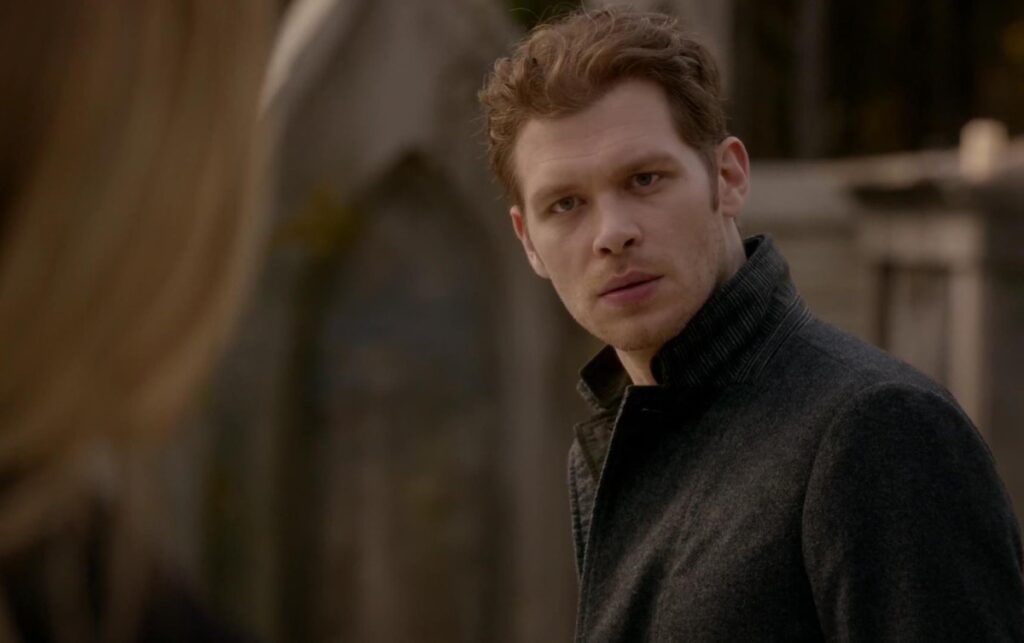
Maybe we might just happen to bump into Klaus Mikaelson.
This is Klaus wondering why I popped up at the house.
Excuse me, sir. Go ahead and resume your vampire stuff. 🙂
We Are Family, I Got All My Readers/Writers with Me
We are bonded through art.
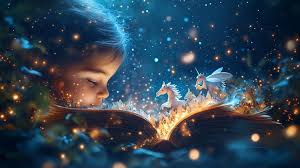
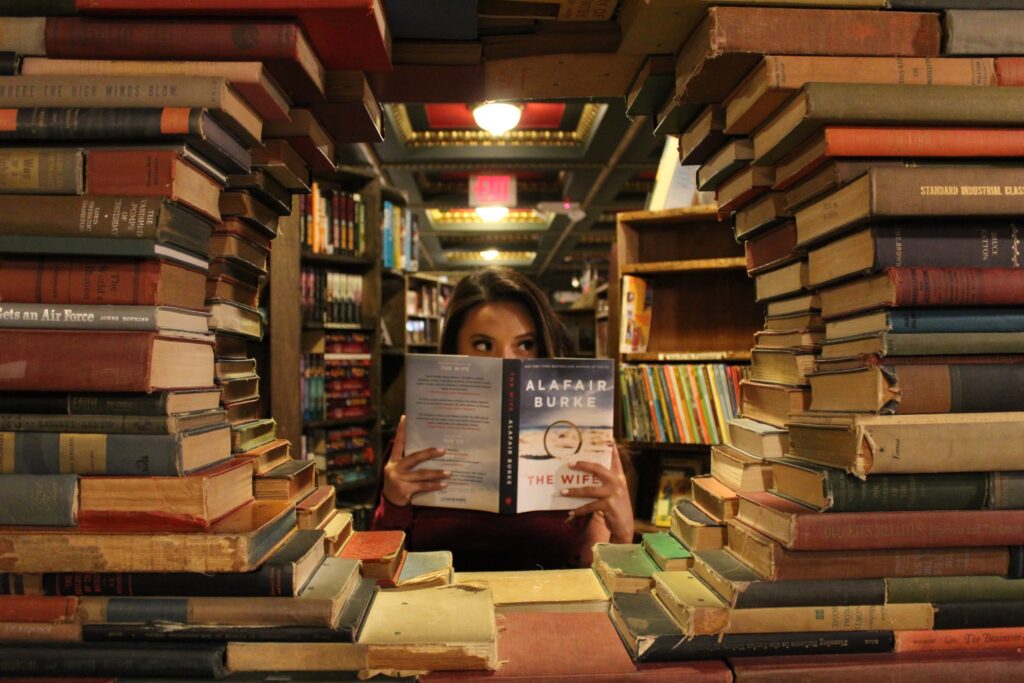
Art highlights our experiences and passions from a young age, as with the little girl in the second row of the Gallery flabbergasted by that turn of events she read. I’m sure we’ve all worn that expression.
I know I have. That scene with Eelyn and Fiske before they went to the fjord 🫣
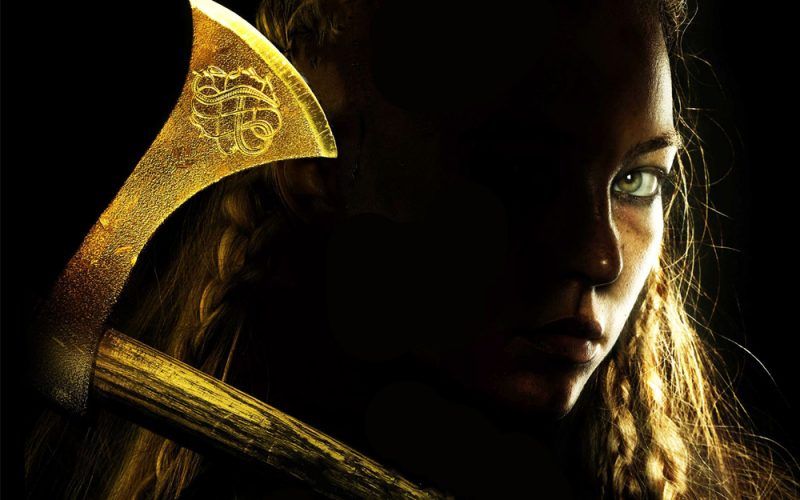
If you don’t know what I’m talking about, go ahead and give Sky in the Deep by Adrienne Young a read.
This Eelyn, by the way. Say hello.
Anyways, the aforementioned Gallery is an accumulation of the ways that literature has shaped us in our lives, from being small children flabbergasted by a turn of events, to teenagers not realizing how Duke couldn’t see that Viola was obviously a dude (like, come on, bro 🙄), to being adult writers that deal with the criticisms of our chosen careers from twats in every direction.
There’s always a touch of criticism coming from the north, east, south, west, northwest, northeast, southeast, Southwest Airlines ✋
However, this Gallery is a collage of the ways that literature is present in our lives, and we don’t need Susan’s approval as to how present we choose for it to be.
Whether it’s ditching the ballet flats for Doc Martens(not that both can’t be worn simultaneously, we’re all about range here), going from T-Swizzle(Taylor Swift, in other words, for those we aren’t cultured) to Bauhaus, or simply deciding what you want to do with your life, someone always has something to say about what you should be doing. Someone is always going to invalidate the direction you decide to take, whether it’s a music choice or career choice.
The chosen path of a writer is no stranger to that.
Just Let Me Write in Peace, Susan!
As I was saying, writers are no strangers to the outside noise of what we should really be doing. I’m sure we’re all familiar with the solace that reading provides. Whether you’re a college student that finds comfort in traveling to Azkaban to calm your mind in between studying or a young parent that finds comfort in a Romeo and Juliet-style of a Viking romance while simultaneously praying the kid stays asleep long enough for you to finish the chapter, reading allows anyone to escape into any world he or she picks up with hands or finds online. Reading allows us to become someone else, hear what someone else hears, feel what someone else feels, go through what someone else goes through. To this day, I still wish I had the power to just transport into any novel or story of my choosing and come back to this world when I feel like it.
Though, it’s possiblethat stems from watching Super Why as a kid.
Now, I know I’m not the only one here who watched PBS as a kid 😒
With how different forms of text serve as a means of expression or safe haven, it’s not that far off for people to decide they want to create those safe havens themselves. It’s not that far off for people to decide they want to create those means of expression themselves.
Whether it’s novels, blogs (obviously), articles, poems, plays, scripts, or reports, writing is a medium (you can also read articles and post your own on Medium).
People have their own notions as to what people need to do with their lives in order to be successful. Little do some people realize is that success is based off on someone’s own desires and goals for their life, not your lists of bullet points he or she needs to tick off for you in order to be considered successful. Success is subjective. Each subject (er, excuse me…person) has his or her own set of criteria for success.
Susan’s success might look like becoming a CEO, while Brenda’s looks like owning a bakery shop.
Keisha’s success looks like becoming a chef, while Kaidence’s looks like becoming a remote freelance writer that gets to travel whenever she’d like.
Mary’s success looks like finally publishing her first novel, while Sasha’s looks like becoming a mother.
Kevin’s success looks like becoming a travel agent, while Mason’s looks like getting his Associate’s Degree.
You get the gist.
Writing Our Success
I understand it’s important to recognize that some occupations you’re passionate about may not pay all the bills, so you have to have other jobs that would ensure financial security while pursuing those passions on the side. You may have to wait until you’re financially in a place to pursue passions full-time.
My own eighth-grade Language Arts teacher had said to me:
“What’s going to put food on the table while you’re writing a book?”
I’ve got to say, she was making some sense. It does make sense to ensure financial security if passions don’t allow it on their own.
However, there are people who may say, “Screw that. I just want to be happy,” and go straight for the passion.
Whichever route is taken, people will always have their own lists of bullet points that you have to tick off for success. For some people, unless you’re addressed as Dr., you’re not successful. For some people, if you don’t have a college degree, you’re not successful. For some people, if you don’t have a certain amount of money, you’re not successful.
For writers, we may hear the following like a broken record:
“How are you actually supposed to make money doing that?”
“Why don’t you get a regular job?”
A writer…yeah, okay.”
“I don’t think that’s a very stable career.”
I don’t remember asking for your opinion, Susan 😒
What people seem to not realize is that there are plenty of ways that writers make their living while pursuing their passion. Some sites that writers may utilize may be:
Yes, there are writers that may work other jobs as well.
Yes, there are writers that manage to make money based off of their writing alone with more experience.
Yes, we’re not Stephen King, but we don’t need to be.
As writers, we all have our strengths. We all have our drives. We all have our lenses of writing through how we express ourselves and communicate. It’s not up to Susan to decide what’s a career or the dimensions our careers need to be built with to be of value.
As writers, we build narratives.
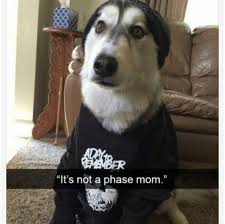
As writers, we also build the dimensions of our careers (because it’s not just a phase).
Disclaimer: I have nothing against people named Susan🤗
The readings throughout the semester so far have allowed me to become more informed and deliberate with my own writing.
I’ve learned how to be more informed with my writing regarding the audience that I’m writing for. Of course, I’ve always written texts in some way or form, whether it’s for personal or academic reasons, but I’ve become more aware of the ways that I should format my writing based on readability. I’ve realized how important it is to maintain an eye on the aspects that would allow people to be drawn towards my writing, depending on the purpose of my texts. Whether the text is for entertaining or informing, I’ve become more informed about the tones that I need to establish within my pieces. Of course, I’ve been aware in the past of the words I need to use to appeal to my audience depending on what I’m writing, going back to persuasive and argumentative essays. For example, figuring out what textual evidence to use to prove my ideas of positions or knowing which nouns or verbs to utilize to further paint the picture that I’m trying to paint.
However, learning more about web writing has allowed me to learn even more how important it is to be aware of the content and style of the text. The content and the style determine how effective the messages from the writing would be, no matter the audience.
I’ve become more deliberate with my writing in regards to using certain styles of format or organization. I’ve become more conscious of the words I choose to have at the beginning of a text that would grab attention, amount of words in each paragraph to appeal to readers’ attention spans, and the use of visuals or graphics to allow more engagement from readers so they’re not just bombarded with a bunch of words they didn’t ask for. I’ve become more conscious of the use of headings, subheadings or bullet points to effectively know how to arrange information so readers know how to compartmentalize certain areas of information.
15 March 2026
Usability
With this site, I believe there are strategies at use that allow for easy navigation for readers. The generally assumed pages that provide information about myself as the author and the site itself are organized in the same layout to allow readers simple access to this information.
There has been the use of format strategies as well to ensure that readers are consuming the content effectively. Aspects such as headers, lists, and brief paragraphs are used in order to allow my readers to be able to digest content rather than get overwhelmed with it due to crammed content.
There is the use of multimedia as well to allow further engagement, rather than risking falling off the attention spans of readers with only utilizing one mode of information.
If I were to use only one mode, readers would get overwhelmed with all of the words being thrown at them with no other form of media to balance them out.
It’s important to create a balance with my content by incorporating media into posts and pages.
I’ve used images to accompany content to allow readers to be able to visualize content or have emotions encouraged from them that would allow them to feel more connected to the content.
Expansion in the Use of Multimedia Content
Though I’ve used images to accompany content, I have realized that the engagement that my site would provide would be improved by the use of videos as well.
It’s not good to only stick to images as an additional form of media, as the lack of more media would possibly have my site not appeal to other uses of different needs who are met more effectively with the use of videos.
Intergetik stated, “A well-produced video that tells a compelling story about a brand, product, or service can engage users emotionally and encourage them to explore further” (Intergetik, 2024).
With this, I’ve realized the importance of incorporating videos into my content rather than becoming overly dependent on images as the way to spice things up a bit.
I know it’s ironic I used an image here, but I’ll start using videos as well, okay? 😒
Though I may be more comfortable with the handling and incorporation of images, it’s important to be able to step out of that zone and familiarize my site with videos as well to expand my site’s engagement factor through greater use of multimedia.
Throughout this semester, I have been given new and extended knowledge on how to produce web content suitable for viewers. I’ve learned how to format and present content.
In the past, I’ve been familiar with writing content, as when I’d make posts on Telegram.
What I had been familiar with was presenting in a personal tone. I had made different posts that each allowed me to connect with readers in a more personal way through the perspective I used, rather than having readers feel as though they’re talking to a board member about the economic and political state of the world right now.
I hope someone gets the reference here. 🤗
Knowledge of the importance of creating an atmosphere that brings readers in.
With this knowledge, I was able to be more informed and intentional with the language I’d use with my content. For example, it’s been taught to not use jargon.
With the use of jargon, we may be using terms that our audience may not be too familiar with and become confused. If the audience becomes confused about the content, they could become confused about the content and the message within it. This would in of itself cause a failure to connect with the audience.
I’ve learned to establish a connection with the audience with a jovial, casual tone.
I’ve learned to use different modes more effectively, such as how to incorporate images more effectively.
In the Writing for the Web textbook it is expressed that we should always have in mind the messages we try to convey with images.
This has allowed me to learn how to use images in ways that would add relevant emotion to what I was trying to convey in its text counterparts.
I’ve learned to use content in a way that is suitable for readability.
Different strategies are utilized by writers in order to promote enchantment. Two of the ways that I’m going to touch on today would be the use of dramatic irony and the separation of identities. With dramatic irony, readers are consumed by literary elements as their beliefs are challenged as the characters’ beliefs or experiences become their own. This experience as readers allows the questioning of identities to come into place, as readers have to learn how to navigate from their own identities and the ones established by the characters and narratives throughout the text.
Enchantment is the path through which we travel through stories.
What Is Enchantment?
Enchantment is how we get lost in stories as readers. It’s how we allow ourselves to let go and become enveloped into the lives of characters. As people, we go through stress throughout our everyday lives. Some people find solace in gardening, some find it in swimming, and others find it in literature. The forms of literature that solace may be found in consist of novels, short stories, poems, plays, and other forms. Enchantment is the process that allows us to find solace by encouraging our minds to let go of stresses as we become consumed by the elements of a piece of literature ranging from its characters to its plot.
I’m going to exemplify strategies of enchantment described above through Rita Felski’s Uses of Literature, Shakespeare’s Twelfth Night, and Iser Wolfgang’s The Reading Process: A Phenomenological Approach.
How the Texts Described Above Contribute To Enchantment:
Rita Felski’s concepts of enchantment take play as Shakespeare takes readers outside of themselves and their world, and puts them into the characters and world of his Twelfth Night.
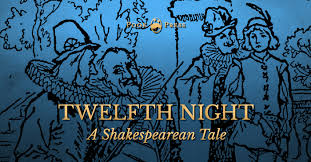
Shakespeare’s Twelfth Night demonstrates enchantment as readers are engulfed with samples of dramatic irony.
Shakespeare’s Twelfth Night demonstrates enchantment as readers are engulfed with samples of dramatic irony.
The Process of Enchantment
Felski had stated, “Disoriented by the power of words, readers are no longer able to distinguish between reality and imagination” (Felski 23). With this, Felski had stressed that the effects of words used within texts have the power to blur the lines for us regarding what’s real and what isn’t. Twelfth Night’s reverse aspects for dramatic irony show this effect with readers. Reversed identities serve as a way to blur between what’s real and what’s not.
The character Cesario is really a woman named Viola, who is in love with Orsino, who is in love with Olivia, while Olivia believes herself to be in love with Cesario(who readers know is really Viola). As readers find themselves enchanted into this world, they find themselves ping-ponging between identities and truths.
Dramatic irony serves to confuse our truths as readers further with the conversation that would take place among these characters.
In Act 2 of Twelfth Night, Orsino had asked “Cesario” in a conversation, “Hath stayed upon some favor that it loves. Hath it not, boy?” (Twelfth Night. 2. 27-28.).
Within this conversation, Orsino had asked “Cesario” about “his” love interest, little does he know that he himself is the love interest of “Cesario.” With Orsino believing Viola to be Cesario, readers fight with knowing Cesario is Cesario as they identify with Orsino, but fight with their own separate identities as readers knowing that Cesario is Orsino.
Felski had stated, “The experience of being wrapped up in a novel or a film – whether “high” or “low” – confounds our deeply held beliefs about the rationality and autonomy of persons” (Felski 54).
👆
That’s a quote to take home(or don’t…no pressure) for all of my quote-lovers out there.
Felski notes how our experiences as readers through text challenge our own beliefs about the different identities among people, and question the rationality behind these identities. Shakespeare expands on this very notion with Twelfth Night, as with the conversation between Orsino and “Cesario,” concerning Cesario’s love interest.
When Orsino had asked of the woman his “lad” was interested in, “Cesario” responded to Orsino with, “Of your complexion (Twelfth Night. 2. 31.).”
Oh yeah, I bet “she” is of Orsino’s complexion. Come on, Orsino, that’s Olivia telling you she’s in love with you. Her facade of a guy can’t honestly be that good 🙄
Though, maybe it was. Viola had Duke fooled in that movie, didn’t she?
👇
“Cesario” is telling Orsino that he’s in love with a woman that has a similar complexion to him, though unbeknown to Orsino, he is that woman Cesario is describing. This confuses us as we all know that “Cesario” is confessing his love for a woman, while there’s another part of us that knows very well that’s really our girl Viola confessing to clueless Orsino.
Wolfgang Iser dives deeper into this separation of identities. Iser had stated, “What is normally meant as “identification” is the establishment of affinities between oneself and someone outside oneself – a familiar ground on which we experience the unfamiliar” (Iser 1230).
☝️
Feel free to take that quote home too(or not, like I said…no pressure).
Iser delves into how our identification with text consists of two separate entities between ourselves and someone who is being established by the text through the unfamiliar information we’re being fed. This unfamiliar information creates a breeding ground for the formation of the other “self” being created by the text.
Shakespeare’s Twelfth Night presents plenty of unfamiliar information that would force this form of identification on us with the unfamiliarity of the festive aspects presented through the characters’ own wavering identities.
After realizing Olivia’s love for “her,” Viola had stated to Malvolio, “What will become of this? As I am man, my state is desperate for my master’s love. As I am woman” (Twelfth Night. 2. 2. 36-38).
Viola had realized Olivia’s affections for “her,” though they were really of Cesario (because our girl Viola played a dude so well that Olivia fell in love who she thought was “Cesario” but really Olivia 💁) Viola was struggling with the realization of the identity she had on the outside as Cesario( who Olivia was in love with), and her inside identity as Viola who was in love with Orsino.
This struggle resonates with our own struggles of the separation that takes place when we read, soaking in multiple identities from multiple characters. The struggle is REAL.
I could be halfway through a book before remembering I’m not actually a Viking on my way to save my people 🧑🦯
Enchantment, Enchantment, Wherefore Art Thou Enchantment?
☝️
(Insert dramatic lovey-dovey music here)
As readers, enchantment will be everywhere. Enchantment will be everywhere we decide to go and everyone we decide to be when we open up a piece of literature. It’s what allows us to become so invested in stories and forget that we’re not actually the woman that Edward and Jacob are fighting over (Team Edward, by the way 🤚).
Enchantment is what allows us to find peace in our stories, quotes, poems, and other forms of literature. Enchantment is what carries us through life as we find solace within the arts that literature provides.
Whatever my insecurities in life, at least I know that enchantment will never ghost me.
🥰
References
Felski, Rita. “Enchantment.” Uses of Literature. Blackwell Publishing. 2008.
Iser, Wolfgang. “The Reading Process: A Phenomenological Approach.” The Act of Reading: A Theory of Aesthetic Response. Hopkins Press. 1978.
Shakespeare, William. Twelfth Night. Edited by Barbara A. Mowat and Paul Werstine. The Folger Shakespeare Library. 1932.
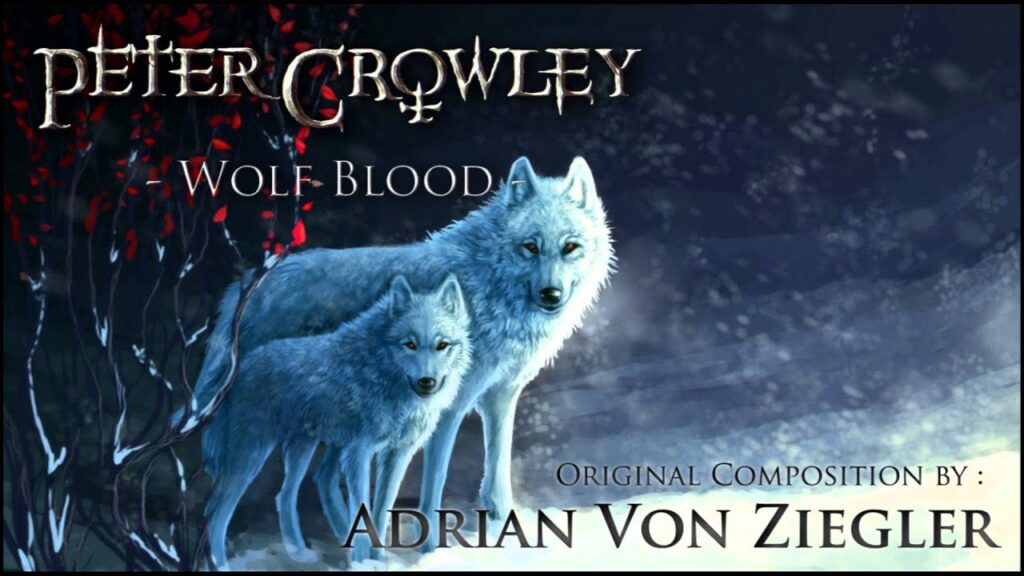
Ambience establishes a setting and atmosphere to provide peace for the mind. Ambience is to allow its listeners to practice mindfulness, being present in the moment, to calm anxieties or allow enchantment into different worlds produced by the mind. There are many producers that work with ambience. Adrian Von Ziegler is one of them, and I believe he does it effectively through his various lenses.
Uses of Ambience
Ambience is used for many purposes. Whether a reader needs to set the atmosphere for a short story or novel or a young woman or man needs some background music for cooking or cleaning, this soundscape industry is utilized for peace. Ziegler manages to incorporate multiple different soundscapes into his work, rather than remaining in one or two themes. Different readers feel attracted to different soundscapes, some may desire ones that have a common theme while others yearn for a kaleidoscope of them. Based on the flexibility in his themes, Ziegler exemplifies the production of multiple soundscapes or themes that readers can utilize, whether it’s to set the atmosphere or calm their minds before entering it.
Variation of Themes
As mentioned before, it’s effective to be able to incorporate different themes. I have listened to ambience producers for quite a few years now for reading and meditating purposes. I’ve come across some producers that utilize a common theme or two. That’s okay, of course, as these producers are tending towards their own audiences. However, some established soundscapes by them are examples of when it’s decided to not differentiate amongst themes. Some soundscapes may not utilize themes that encourage mental expansion into different lenses that could assist with different areas of readers’ minds or different tasks. For example, below are a few works by producer, Inn House:
This video utilizes a fireplace in a sitting room with snow falling outside with an ocean view to establish a cozy winter coastal setting.
As seen, Inn House tends to use a common cozy theme adorned with a fireplace and an ocean. Though, it is to be noted that Inn House has produced a few videos that stray from this common theme, such as one with sounds of rain outside a window. However, the soundscapes produced are an example of those that tend to follow a common theme.
Incorporating different cultures and aspects, Adrian Von Ziegler tends to differentiate among themes established. Here are a few below:
This video sets a setting for stories through calm Japanese melodies that set an epic tone. This may be applied to aspects of voyage, coming-of-age, dystopian, and etc.
Through the use of themes, Ziegler maintains a kaleidoscope of settings that could apply and appeal to various states of mind. Though, it is to be noted, he doesn’t tend to produce a few videos that only have nature sounds(as Inn House does). For example, he has one that has nature sounds but is accompanied by soft music.
Tone Set By Ambience
Overall, it allows for different areas of the mind to be activated through different lenses when producers establish various settings rather than mainly utilizing one or two common themes. Don’t get me wrong now, producers like Inn House know their own audiences and manage to differentiate while staying within a certain theme. That is an efficient skill. Though, if I were to recommend a producer for readers to listen to in regards to forming mental settings for books, I’d say Adrian Von Ziegler or those that often incorporate different settings. It’s important to set different tones through settings that apply to various areas of readers’ minds that are shifted towards different environments.