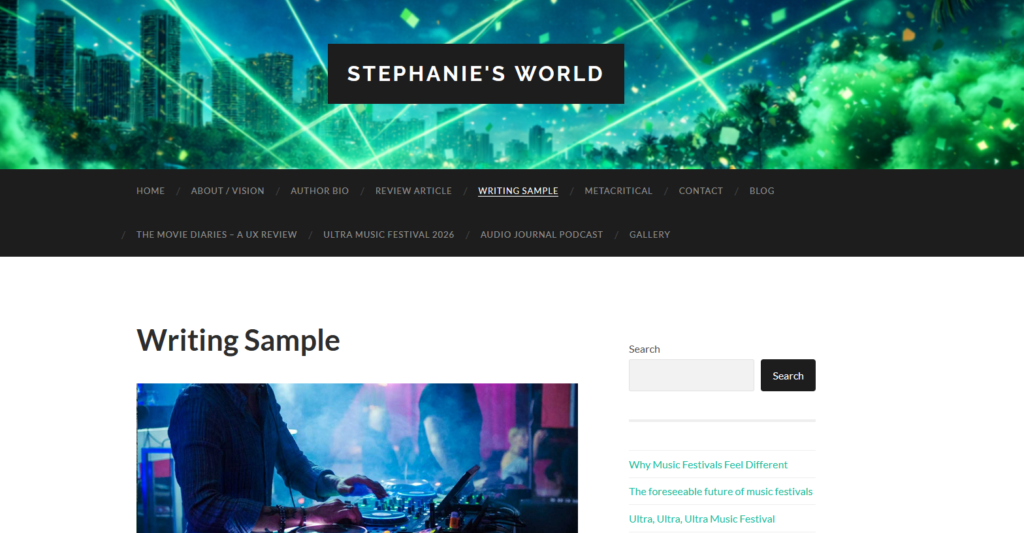
Attention innovators and thinkers, it is my utmost pleasure to announce that the world of Stephanie’s mind is a limited domain no longer.
With the release of an official social media—a dedicated Instagram and YouTube platform—Stephanie’s Worldis no longer confined to the boundaries of web writing, but a wider plane; a galactic host of musical magic and melodic memoirs reaching beyond to universal heights!
Over merely three months, Stephanie has richly developed her world into a special discography of personality and passion, one swayed by the sound of music and mirth with novel journal entries like her “Ultra Music Festival 2026”, where Stephanie records and reviews her experience attending Miami Music Week.
What was just a small series of blog posts has now rocketed to greater heights, as Stephanie’s World has rightfully branched into audio formats with her new journal podcast, recounting compelling non-fiction stories sure to enmesh any into Stephanie’s own realm.
We fellow innovators are always in the market for innovation, and what better place to discover it than in Stephanie’s World, where music and memoir entwine.
Inside the mind of Stephanie, you are guaranteed to find wonder in her own original analysis of the Social Media DJ, nuanced hindsight into the gradual shifts in music festivals, or even the inevitable future of the music industry. Follow her melodies and enter a world of melody, spotlights, and earth-shattering tunes!
Prepared by Felipe Vargas for Dr. Vytautas A. Malesh and Stephanie Loor
Introduction
This report offers a thorough appraisal of Stephanie Loor’s website, “Stephanie’s World”, examining its efficacy in web writing practice and reviewing its accessibility as a personal blog.
This report determines in its evaluation that Loor’s site largely adheres to the requisite web writing principles provided by Dr. Malesh and his course materials, which promotes usability, complete content, and stylistic writing—criteria that Loor sufficiently meets according to the evaluation of this report.
Loor demonstrates steady control over their tone and authorial voice, shifting to an authentic and intimate writing style for their blog posts and an informative, promotional voice for their review. All mandatory content is arranged and accounted for, yet there remain areas that Loor can further elevate, such as:
Presentation
Formatting
Organization
Rhetoric
Overall Impression
“Stephanie’s World” is an apt name for the website, for the reader is truly welcomed and absorbed into Stephanie’s world; that’s mistimed break-ups and pure musical passion for mixing and DJ’ing.
The care and attention to the subject is undoubtedly palpable, as there is an utter knowledge on display for music production that amplifies the credibility of the speaker, but this content is ultimately hindered by its lack of stimulating visual design and chunking, which damages the capacity for the brisk reading pace typically set by online readers.
“Stephanie’s World” excels at writing a uniquely personal blog post about the interests of one Stephanie, but it staggers in its ability to effectively satisfy the needs of visitors. If “Stephanie’s World” can improve its application of web writing to further inform its audience, then “Stephanie’s World” can truly be professional-grade.
Specific Strengths and Loci of Improvement
Strengths
Tone and Style
“Best Practices for Web Writing” by the University of Maryland Baltimore recommends that, “Readers expect a personal, upbeat tone in web writing. They find bureaucratic writing offensive and out-of-place and ignore the message it’s trying to convey.”
Loor shows a masterful control over the expected web writing tone, one that cleverly balances their candid, nakedly honest style with the conversational informality of blog writing.
Image Work
“Web Article Style” by Dr. Malesh guides web writers to “insert an image”, because pictures have the merit of enhancing the aesthetic and visual interest of pages while continually reinforcing information to the reader.
Loor exercises this practice quite well in such a manner that it emphasizes the tone of their blog, maintaining a light and often humorous visual attached to their content.
Image from Stephanie’s World, “Heartbreak Before Valentine’s Day”.
Loci of Improvement
Site Architecture and Navigation
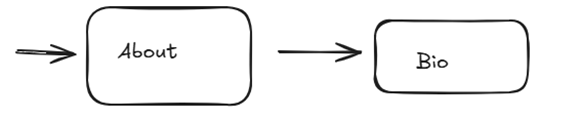
“Stephanie’s World” doesn’t quite maintain the recommended site architecture recommended by Dr. Malesh, which stipulates that the About page should directly channel into the Author’s Bio and that, “Your metacritical write-ups… should be accessible only via a link you send me and not off the home page.”
I recommend that Stephanie adjust their menus to merge the About Vision page with the Author Bio page to better adhere to professional site architecture. Moreover, I advise Stephanie to consider creating categories for their posts and place their metacritical self-assessment under its own separate category off the home page menus.
About and Bio Page
In “Web Page and Article Types” by Dr. Malesh, he writes that, “The ‘about’ page explains the purpose of the site… But what is the site doing… What is the site here to do?”
Stephanie Loor adequately answers this question in their About/Vision page, but I advise that there is clearer, more specific language utilized to inform readers about what the site truly is, as there is a great dearth of factual information within the current draft of the About pages, which is both recommended by Susan Greene in “How to Write a Killer ‘About Us’ Page” and William Craig in “Guidelines for Writing a Good About Page”.
Chunking
Both Dr. Malesh in “Web Article Style” and “Best Practices for Web Writing” press the importance of brevity, simple sentences, and short paragraphs, respectively: “A paragraph should consist of 70 words or fewer.”
In most of Loor’s content, there are sections that nearly extend past 200 words. These areas are in need of chunking to promote skimming and a brisk reading pace.
Conclusions, Affirmations, and Recommendations
“Stephanie’s World” is a promising launching pad into the mind of Stephanie Loor, because the writing and tonality drive this raw sense of candor and truth that renders the blog a deeply engaging and personal reading experience.
But “Stephanie’s World” can better enhance this potential through improved formatting, chunking, and navigation. Subsequently, Susan Greene in her article, ““How to Write a Killer ‘About Us’ Page”, advises readers to tell a story: “… the best public speakers often communicate their information by telling personal stories. Apply that winning technique to your About Us page and you’ll forge a connection with your visitor.”
Stephanie Loor’s website is at its pinnacle quality when it attempts just this: telling a story, whether relatable or otherwise, and Loor’s Bio is lacking in this storytelling aspect. What are their humble beginnings and why, as a visitor to their site, should we invest ourselves in these anecdotes?
With more narrative and anecdotal focus on Loor’s life and personal interests, I feel that “Stephanie’s World” can truly catapult us into… Stephanie’s world.
Eberron: Forge of the Artificer is less of the expansion it was purported to be and more of a refurbishing, a safe orientationof a rustic, yet cherished D&D campaign setting. It failed to truly renovate its rich and treacherous world for newer audiences.
Released on December 9th, 2025 by Wizards of the Coast, Eberron: Forge of the Artificer was poised to reintroduce the Eberron setting back into the mainstream D&D catalogue, revitalizing it for the latest version of D&D fifth edition.
You see, the last official transfusion of content Eberron has received was in 2019 in the form of Eberron: Rising from the Last War, and it was a 320-paged atlas brimming with exciting, fantastical lore and dense, interesting mechanics.
Since then, Wizards of the Coast decided to update D&D fifth edition in 2024, promising a new launch for all iconic D&D settings and rules.
Naturally, this left fans of Eberron wondering how their war-torn world will fit into the schematics of this new update.
Yet, Eberron: Forge of the Artificer should’ve rekindled some of the fires in those furnaces, because for its steep price, inaccessible design, and misdirected quality of writing, this sourcebook becomes a faulty patch for any to cross into the world of Eberron.
Price Unbefitting the Content
Eberron: Forge of the Artificer is approximately thirty US dollars.
That is 10 dollars less than its stocky predecessor, meaning that Forge of the Artificer should boast enough content to at least rival that of Rising from the Last War.
But it doesn’t.
Forge of the Artificer promotes a series of rule revisions, about 50 player options, new spells and mechanics, and 3 storytelling frameworks for potential campaigns—and it still doesn’t compare to the meaty content offered in previous installments.
Forge of the Artificer hosts 112 pages.
Rising from the Last War hosts 320 pages.
The page count encapsulates this disparity in content, and this cannot be a mere difference in ten dollars between two widely different products.
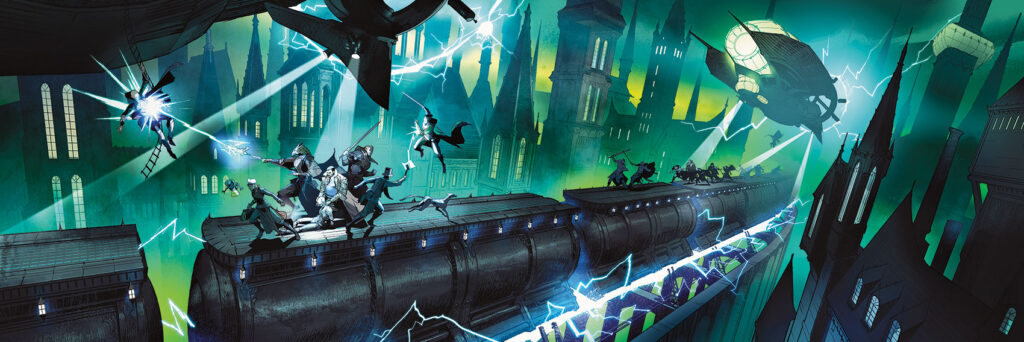
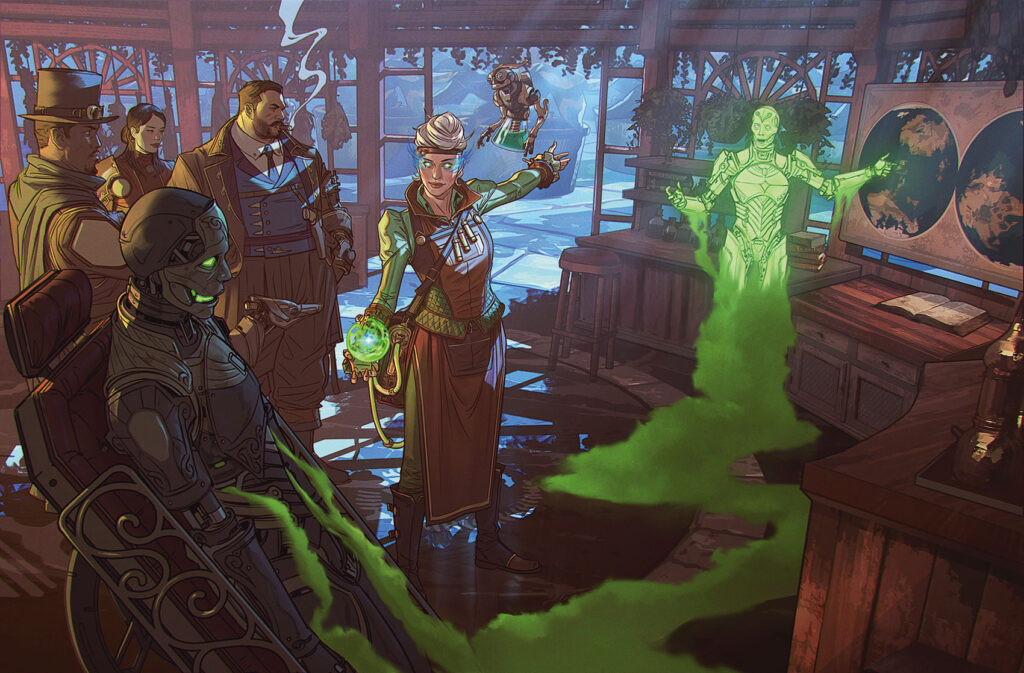
This 2025 release features a noticeable dearth of maps, a valuable resource for game masters and writers but this is somewhat rectified by the sheer quantity of stunning artwork.
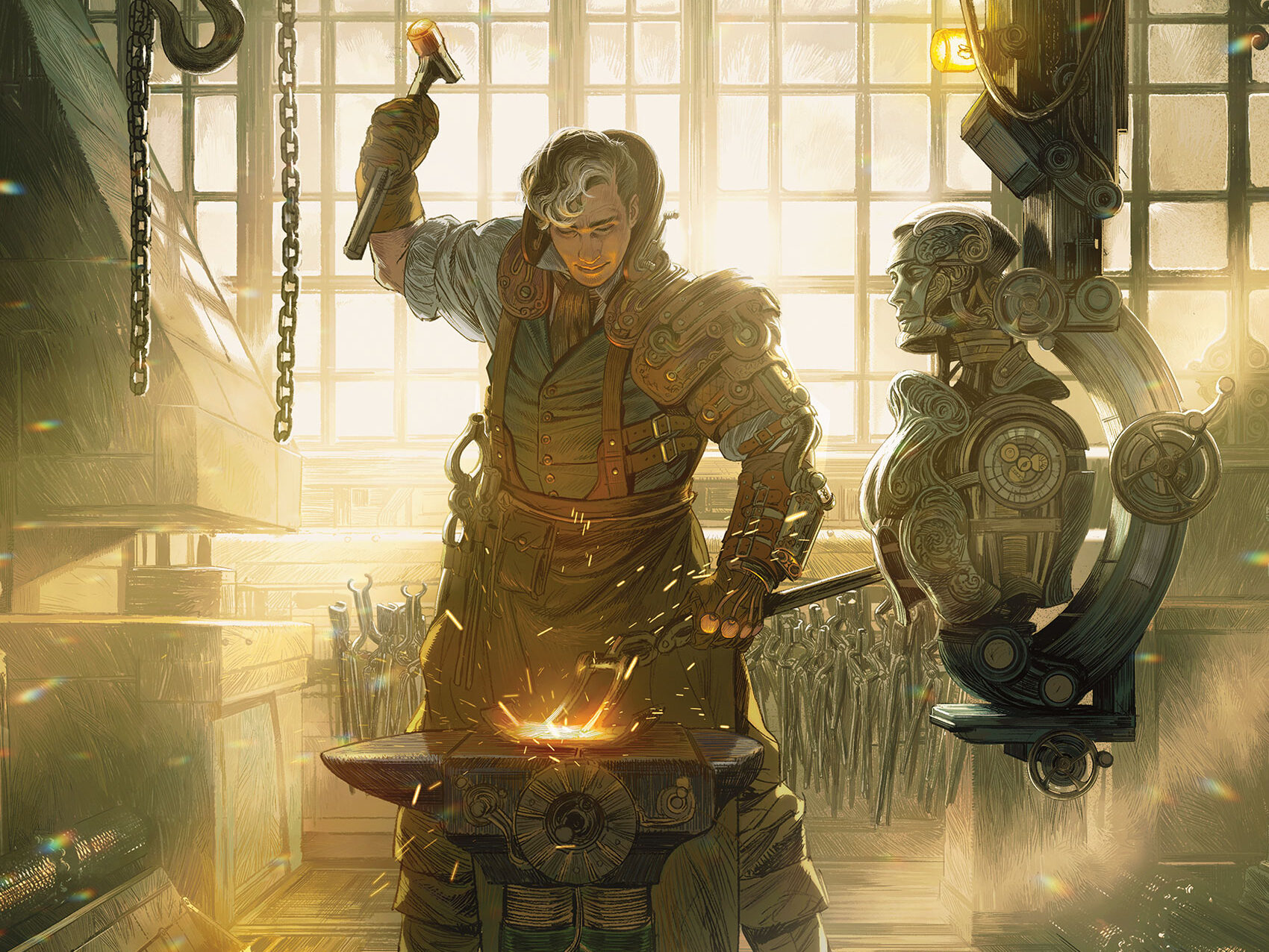
The art of Eberron seemingly reorients the setting back into a meld of arcane noir and industrial pulp fiction. Previous versions were resistant to adopting steampunk as an aesthetic, which only polarized fans.
This new art direction is a flight in the right steamship.
Inacessible Components
Eberron: Forge of the Artificer is drastically underwritten for its price and it often defers to its 2019 release for relevant information.
For thirty US dollars, consumers can pay to be recommended they purchase an additional, older sourcebook that is pricier than the one they are currently reading.
This is no standalone product, because it predicates its content on ownership of other sourcebooks.
It’s a plain misstep for what should be a relaunch, but it instead becomes a thin supplement.
Misdirected Writing
Forge of the Artificer is releasing in the advent of a new D&D edition, drawing droves of new players to new settings.
To have the writing of Forge of the Artificer gloss over any regional, historical, or background information in favor of material revision is a colossal oversight.
Huge swaths of the setting lore is unaddressed for new readers.
What best encapsulates this false direction is the bestiary of Forge of the Artificer, which hosts a number of statblocks for monsters to use in campaigns. One of them is a “Daask Raider”.
What is a Daask?
Well, there’s about three paragraphs worth of information to learn that, and it’s attached to the very statblock in the bestiary. Wonderful.
Sparking Nothing
Eberron needs to forge a new path, or flee from the one they’re headed.
If Eberron is to survive this new cycle of D&D canon, there needs to be more attention and care in building up the world of Eberron, not the forge of some anonymous artificer. It’s almost a comedy to witness the hesitancy of WOTC.
They should seek to build hype about playing in this technological, magical world,not fabricate an artificial update that appeases nobody but old fans and shareholders.