
Language court officers, #courtinterpreters, are responsible for accurately conveying information between parties that speak different languages. A clear record depends on it.
Recalling names, numbers, addresses, and complex legal concepts without mistakes is one of the attributes that separates high-level interpreters from the rest. Professionals in this field understand how important it is to keep their memories sharp.
Understanding Memory
Queensland Brain Institute defines memory as the process of encoding, storing, and retrieving experiences and knowledge. These are notably complex processes, and each one brings its own set of challenges. This information processing software, aka memory, enables humans to develop language, become a social bug; and build a personal identity as unique as fingerprints.
- Visual encoding is converting a visual stimulus, in other words, what we see, into a storable memory. This visualization would reach the visuospatial sketchpad, building up your iconic memory.
- Acoustic encoding: is the processing of auditory stimulus to be stored in our memory through the phonological loop (important)
- Semantic encoding is the processing of abstract sensory input like concepts, ideas, and definitions.
Note: there are more types of memory encoding.
–storing: it is the process of saving newly acquired information in order to be retrieved at a later time. It consists of three stages (image from https://courses.lumenlearning.com)
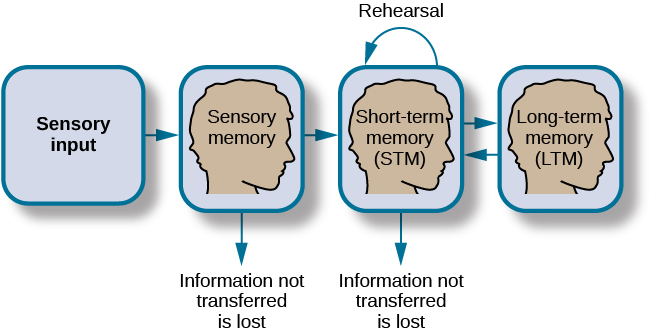
Judicial court interpreters rely heavily on their short-term memory, especially in their phonological loop acuity. This working memory component allows for the processing of sounds and coding and decoding them into the target language, successfully blending them together to form a word.
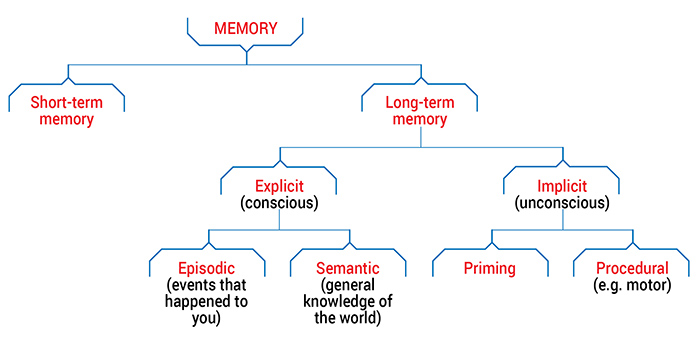
Types of memory.
Yes….but who cares?
A concise understanding of the different memory types will aid beginner interpreters in ‘training’ their money-makers.
Consecutive interpreting- the most used mode of interpreting in the courtroom- depends on the interpreter’s short-term memory, which will store the information for about 30 seconds before recalling it in the target language.
Echoic memory would be the key term in this regard. It’s the ultra-short-term memory for things you hear, and it is part of sensory memory.
Circling back to the phonological loop, or phonological working memory, it has to be mentioned that it supports vocabulary building; sentence and discourse processing, among other skills. It would also supports, and boost your echoic memory while it is momentarily saved as iconic.
The Complete Interpreter podcast posted an episode about how you can make the best use of echoic memory during interpreting assignments.
It all comes down to sweat and tears, but intelligently. Once you have a good understanding of how memory works, you can focus on the right type of memory-building exercises. You can take advantage of the tools and resources on the internet to improve your money-maker.
Be consistent with your practices. Do a deep introspection so you can quickly detect any intrusive memories that might be connecting your phonological loop with the memory of uncomfortable situations. Keep in mind that vicarious trauma is a real thing, and you don’t want it mixed with your personal baggage.
Interpreters must remain emotionally detached at all times. Keep it iced!